

Ten years ago, I wrote a post on organizing music for ballet classes, where the question to myself was “how do you categorize, order, and store the music that you know in a way that makes it quick and easy to retrieve?” More recently, I’ve been pondering that question from the opposite direction: what categories and ways of thinking about music enable you to expand your repertoire? The prompt for that was the realization that some of my favourite new additions to my repertoire came via routes that are impossible to replicate as a process or routine. By the same token, when it comes to finding music for class, it seems to me that systematic methods of increasing your repertoire are not that productive. You’d think that Spotify’s recommendation algorithms might be really helpful here, but they mostly aren’t, in my experience: Spotify doesn’t know that you put pieces in a playlist because the person you play for on Tuesdays likes them. Even if Spotify returns a few things that are in the same stylistic ballpark as the playlist it’s attempting to expand, there is rarely an “aha” moment in them, no sense of having struck gold. Is it any wonder, when you consider the ways that you discover the things that you play? Here’s a few examples:
Distant relations
I was playing Noël Coward’s I’ll see you again (1929) for a ronds de jambe exercise in Renato Paroni’s class at ENB. It’s a piece that almost no-one knows unless they’re my age and above, or a Coward fan. As I was halfway through the middle eight, Renato turned to me with delighted astonishment, and pointed at the piano and mouthed something like “Oh you’re playing that song that I didn’t think you knew.” I smiled, as with both hands occupied and a limited range of facial expressions available, I couldn’t mime “Whatever you think I’m playing, it’s probably not that.” At the end of the barre, he explained that he thought I had been playing Mascara Negra (1966), a popular vintage Brazilian carnival tune and began to sing the part of it that he’d recognised. I was sceptical that two songs so culturally and temporally distant could really be alike, until I went home, searched the song, and found that, just as Renato had said, there is a distinctive line in the middle of both songs that is almost identical in melody and harmony.

Musical boundary objects
A related phenomenon is when you find something by systematic means, and it turns out to be a thing in the world for a completely different reason. I can’t even remember why I was looking up songs by Joe Dassin, except that it was probably because I like French chansons for class, and had fallen down a terrier du lapin in Spotify. I found Les Champs Élysées and as it’s great class material, put it straight into my repertoire. The first time I played it, one of the youngest dancers in the room started singing along. “How do you know that song?” I mouthed after the exercise. “Everybody knows that song” he said, at which I felt a bit stupid, especially when I found out that it had been sung relentlessly during the Paris Olympics in 2024, after France’s win at the 2018 world cup, and by the gilets jeunes protesters (see this fascinating article on the song from the FT for more). There are other examples of this: as I’ve related before, the long-retired old song known in Britain as Roll out the barrel is still widely known in Czechia as Škoda lásky, and in 2000 was voted the number 1 hit of the (20th) century in that country, a fact I wouldn’t have discovered if I hadn’t played it once for class in a Czech company class, and saw everyone turn round and smile.
Other things you adopt not because they belong to a musical category, but for some characteristic that is particularly useful for class, regardless of where the piece comes from, who wrote it, or whether anyone knows it. Like La petite valse, a piece that I love for its French café sound, but even more for the fact that it’s perfect for any exercise that needs a whole-bar anacrusis like someone swinging a sledgehammer, with a corresponding energetic bounce off the “one” when it eventually comes. I’m slightly ashamed to admit that people have sometimes said excitedly “Oh that’s that song from such and such a film” and I’ve been completely unaware and uninterested in the context or provenance, and only interested in the fact that the piece in question happens to work for grands battements.
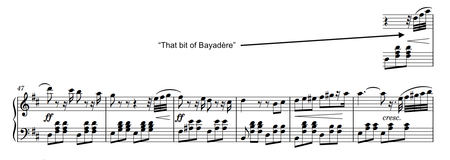
“That bit of Bayadère”
Then there are the snippets of ballet repertoire that teachers sometimes sing or ask for as the ideal accompaniment for a movement they’re teaching. There’s a bit from La Bayadère that several teachers have wanted for class, and in the heat of the moment when I first clipped it for my stock of useful bits and pieces, that’s what I called it in the MobileSheets app on my tablet—”that bit of Bayadère.” Giving it that name has proved invaluable to me whenever the heat of the moment returns, and I know what I’m looking for but can’t give it an orderly name like an act and scene number.
I started thinking about this again after talking to a ballet pianist friend about what prompts we give ourselves to think of things to play on the way to (or during) class. Some of mine are: pieces that begin with a particular letter of the alphabet (some Cs: conga, Chaminade, chaconne, Chattanooga Choo Choo, Chopin); music from particular countries, titles with a particular word in (rose, love, happy); music in a particular key, or avoiding a particular key, or following a pattern, e.g. if you’ve just played in G, think of something in the relative minor (E minor), or in G# major or minor, or going up the circle of fifths, in D; songs written by Cole Porter, Hoagy Carmichael, or sung by Ella Fitzgerald, or Judy Garland; music by particular composers like Prokofiev or Mozart.
Priming the pump
These mental routines don’t prescribe what you’ll play, they just prime the pump, so that you have more in your short-term memory to work with, and hopefully avoid too much repetition, getting stuck in a rut, or simply forgetting what you know. In the course of a class, you might use none of the things you think of. It often happens that a teacher marks an exercise, and something just comes to mind in a flash of instinct from watching or empathizing with the movement, and you couldn’t say why. . You didn’t arrive at that choice through any kind of categorization or method, only by seeing a movement and inwardly hearing music.
I’m not sure why I’m even posting this, except perhaps to say to anyone who’s a dancer or teacher working with a pianist: it really helps when you talk about music that you know and love, or that really works for an exercise, far, far more than using generic descriptors like time signature or dance styles. I wonder if those things (time signature or dance style) are best thought of not primary categories at all, but as something similar to the filters you apply on internet shopping sites: once you know what it is that you want, then you start filtering for things under £200 that are Mac-compatible, say. But to start with those categories as search terms would be absurd.
In a book—I think it might have been Supersizing the Mind by Andy Clark, but I’m not sure—I read about a hardware store (fictional or real, I can’t remember either) where things were not arranged on the shelves according to categories but apparently at random. Nonetheless, the store owner always knew where things were, through familiarity with the environment, and where things were in relation to each other. It seems to me that this is closer to what it’s like to find or look for music for class, and that categorizing can be a form of overkill that serves only a limited function in this context. From that perspective, the process of “priming the pump” that I described is perhaps the equivalent of walking around the hardware store just to remind yourself of what you have. Applying random filters like “things beginning with C” helps to circumvent the problems associated with trying to categorize too rationally.
